Monastery Meditation Retreats in Thailand: Wat Pa Tam Wua vs Wat Ram Poeng vs Suan Mokkh
Thailand has hundreds of monasteries, and many of them accept lay guests. For foreigners who want to meditate in English, three names come up again and again: Wat Pa Tam Wua in the northern mountains, Wat Ram Poeng in Chiang Mai, and Suan Mokkh in the south. They are all Theravada Buddhist monasteries, and they are all cheap or free. But they offer very different experiences.
I lived at Wat Pa Tam Wua for 20 days, described in a story I published in 2020, so that section includes first-hand experience. Disclosure: I also built the monastery's website and still maintain it as a volunteer. I have not stayed at Wat Ram Poeng or Suan Mokkh. Everything I write about them comes from their official websites, which I checked in October 2026. Rules and dates change, so confirm before you travel.
Wat Pa Tam Wua vs Wat Ram Poeng vs Suan Mokkh at a glance
| Wat Pa Tam Wua | Wat Ram Poeng | Suan Mokkh | |
|---|---|---|---|
| Location | Mae Hong Son province, Highway 1095 between Pai and Mae Hong Son | Suthep, Chiang Mai city | Near Chaiya, Surat Thani province, about 640 km south of Bangkok |
| Format | Open monastery with three daily classes (walking, sitting and lying-down meditation) | Individual Vipassana course with a daily report to the teacher | Group anapanasati (breath meditation) retreat |
| Length | Usually 3–10 days; longer case by case | 26-day basic course; stays of 10 days to 6 weeks possible | Exactly 10 days, 1st–11th of every month |
| Cost | Free; voluntary donations | 500 THB one-time fee; voluntary donations | 2,000 THB, non-refundable, all included |
| Booking | None; walk in 06:00–16:00 | Email, phone or walk-in; fixed check-in dates | In person only, on the last day of the previous month |
| Silence | Optional ("Silent" badge); silent in class | No talking, reading or writing during the course | Complete silence, except interviews on days 3–6 |
| Phone | Allowed, kept silent | Kept in a safe box | Handed in for the whole retreat |
| Language | English and Thai | Ask when you apply | English |
| Best for | Beginners, short stays, travelers near Pai | Serious, long, individual practice | A classic silent 10-day retreat |
Wat Pa Tam Wua: the easiest first retreat (and the one I know)
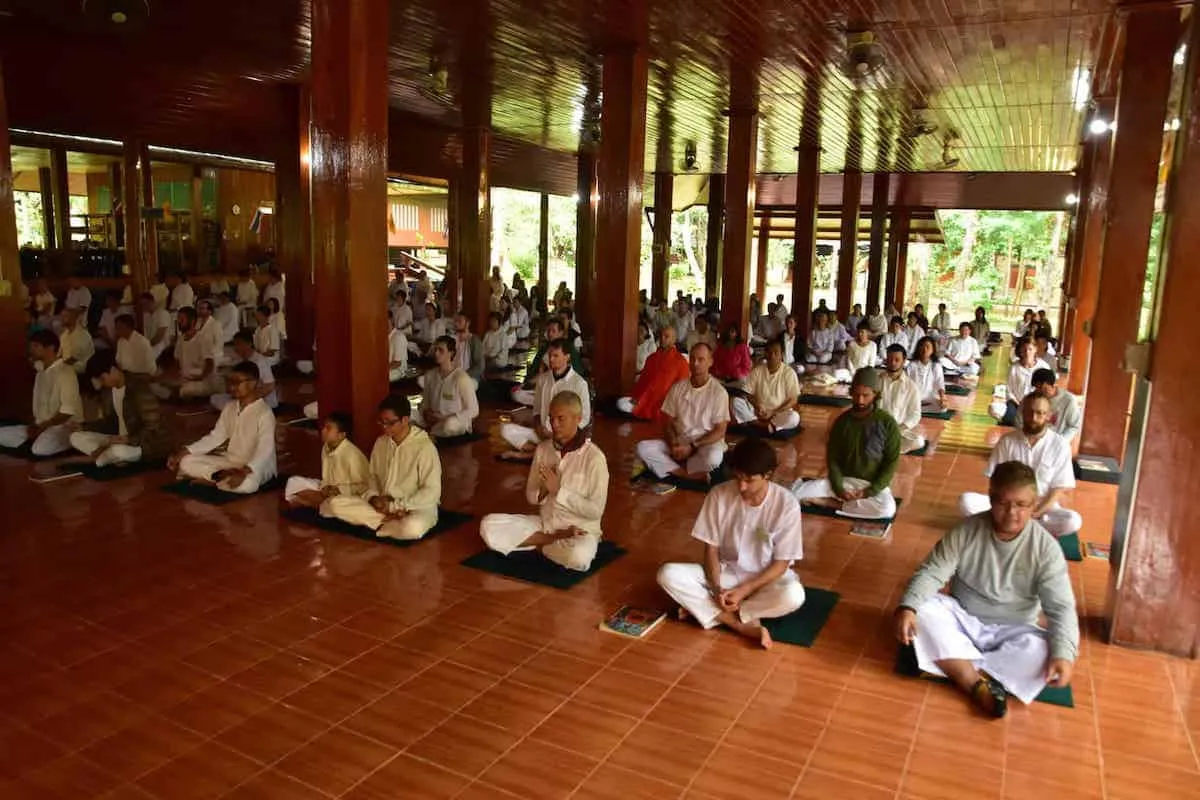
Official facts (wattamwua.com, October 2026). Wat Pa Tam Wua is a Theravada forest monastery in the Thai Forest tradition, about 37 km from Mae Hong Son town on Highway 1095, between Pai and Mae Hong Son. There is no booking: you walk in any day of the year and check in at Information between 06:00 and 16:00 with your original passport. Most guests stay 3–10 days, with at least 3 recommended. Accommodation, white clothes and two vegetarian meals a day are free, and donations are voluntary.
The day starts at 05:00 and includes a rice offering to the monks and three mandatory classes, at 08:00, 12:50 and 18:00. Each class combines about 40 minutes of walking meditation, 40 minutes of sitting and 15 minutes lying down. Teaching is in English and Thai. Silence is optional outside class, and phones are allowed if kept silent. The rules follow the Eight Precepts, with zero tolerance for smoking, drugs, stealing and sexual activity.
My experience. We chose it because the monks speak English and we wanted to understand the teaching, not just sit. The days were slow and calm: meditation, talks, small jobs around the grounds, and time to ask the monks questions after every class, which became my favorite part of the day. My mind grew calmer day by day. It felt welcoming rather than strict, which makes it a good place to find out whether monastery life is for you.
Getting there, the full timetable, what to bring and my story are in my complete Wat Pa Tam Wua guide. It is also the obvious choice if you searched for a "Pai meditation retreat": the monastery is roughly 70 km from Pai.
Wat Ram Poeng: intensive Vipassana in Chiang Mai
Wat Ram Poeng, also called the Northern Insight Meditation Center or Wat Tapotaram, is in Suthep, Chiang Mai (Chiang Mai 50200). Its main program is a 26-day basic course in Vipassana with individual guidance from a teacher. Graduates can come back for a 10-day retreat. If you cannot do the full course, the center accepts stays from 10 days up to 6 weeks without special permission, according to its course page.
- Daily life: wake at 04:00, breakfast at 06:00 and lunch at 10:30, with no evening meal. You report to your teacher every day around 14:00.
- Rules: no talking, reading, writing or phone calls during the course; phones go into a safe box. White clothes day and night (bring at least two sets, or buy them at the temple store). Eight Precepts and no smoking.
- Cost: a one-time fee of 500 THB for laundry and ceremony supplies. Donations are voluntary, on the last day.
- Booking: by email, phone or walk-in, with your passport and a photo. Courses start on fixed check-in dates at about 08:00, and the check-in ceremony is not held on Buddhist holy days (wan phra). The dates are listed on the information page; when I checked, it showed 2027 dates.
Best for: people who want a serious, structured Vipassana training with personal teacher contact, and who have nearly a month to give. Being in Chiang Mai also makes it the easiest of the three to reach.
Suan Mokkh: the classic 10-day silent retreat in the south
The Suan Mokkh International Dharma Hermitage is in Chaiya, Surat Thani province, 1.5 km from the main Wat Suan Mokkh monastery off Highway 41. It is about 640 km south of Bangkok, 53 km from Surat Thani and 6 km from Chaiya railway station. It runs one thing: a 10-day silent retreat from the 1st to the 11th of every month. There are no shorter or partial stays.
- Practice: anapanasati (mindfulness of breathing), taught entirely in English, under the Eight Precepts.
- Silence: complete, except for interviews on days 3 to 6. Phones, tablets and notebooks are deposited for the whole retreat.
- Registration: in person only, on the last day of the previous month, 07:00–15:00. There is no advance booking. You can stay for free the night before at the main monastery.
- Cost: 2,000 THB, non-refundable, covering everything.
- Provided: a single room with a hard bed, straw mat, mosquito net and wooden pillow; two vegetarian meals plus an evening drink.
Details are on the hermitage's registration page. Best for: people who want the full silent-retreat experience on a fixed schedule, and who can plan their trip around the start of a month.
Other options
In Chiang Mai, the International Buddhism Center at Wat Phra That Doi Suthep is also often mentioned. It is reported to run individual courses with no fixed start dates, about three weeks for beginners, but I could not confirm its official website or costs, so contact the temple directly.
How to choose a monastery retreat in Thailand
- You have less than a week, or this is your first try: Wat Pa Tam Wua. Minimum 3 days and no booking.
- You want a strictly silent retreat: Suan Mokkh. Arrive on the last day of the month before.
- You want a vipassana retreat with a personal teacher: Wat Ram Poeng, if you can give it 26 days (or at least 10).
- You are on the tightest budget: Wat Pa Tam Wua is free; the other two are very low cost.
- You are already in the north: Wat Ram Poeng (Chiang Mai) or Wat Pa Tam Wua (Pai–Mae Hong Son). In the south: Suan Mokkh.
- You need your phone for work or family: only Wat Pa Tam Wua lets you keep it, as long as it stays silent.
How to prepare for a Buddhist retreat in Thailand
- Check your visa. From 15 September 2026, citizens of 60 countries and territories, including all EU states, get 30 days visa-free for tourism, according to the Tourism Authority of Thailand. A 26-day course plus travel will not fit easily into that, so plan a visa or extension. Every foreign arrival also needs the free Thailand Digital Arrival Card (TDAC). Monasteries check your original passport.
- Plan around start dates. Suan Mokkh registration is on the last day of each month; Wat Ram Poeng has fixed check-in dates; Wat Pa Tam Wua closes check-in at 16:00.
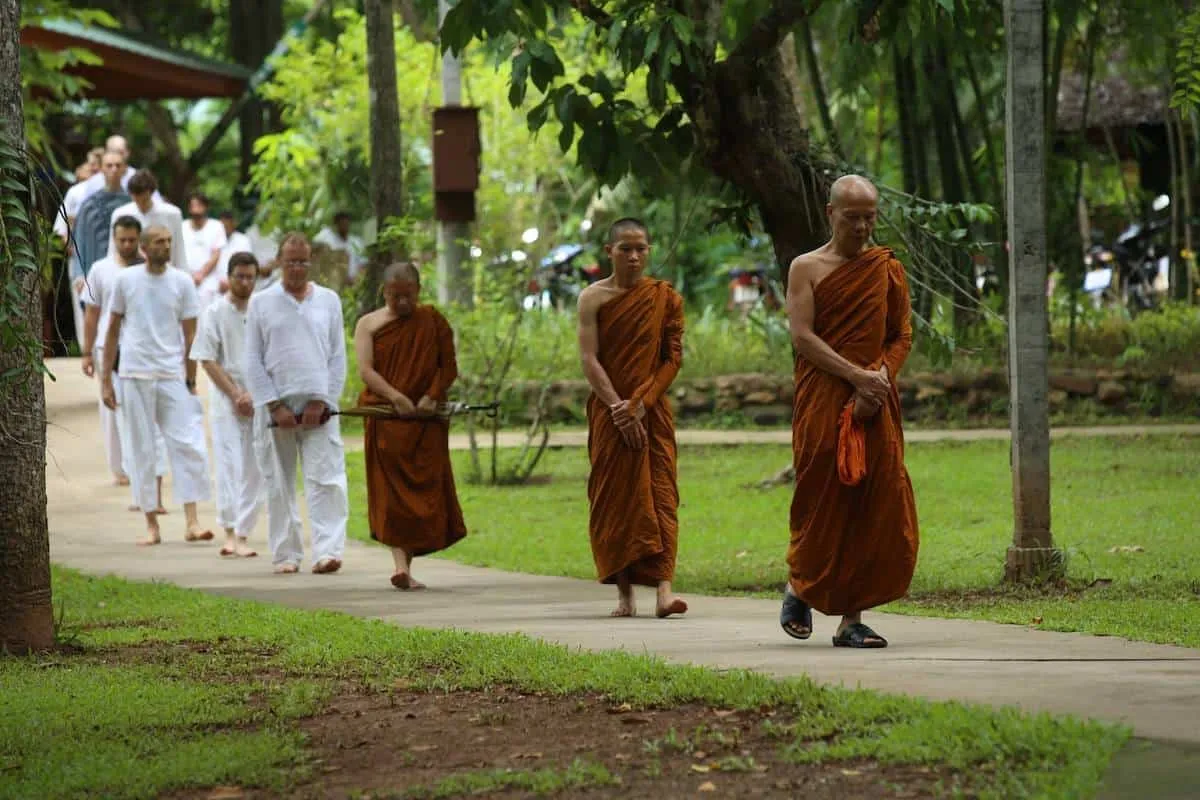
- Pack light and modest. White, loose clothes that cover the knees (Wat Pa Tam Wua lends them; Wat Ram Poeng sells them), a warm layer for cool northern mornings, mosquito repellent, a flashlight and some cash.
- Practice the basics at home. Try sitting still for 20–30 minutes, getting up early and skipping the evening meal for a few days. Wat Pa Tam Wua and Wat Ram Poeng serve no full meal after lunch; Suan Mokkh serves two vegetarian meals plus an evening drink.
- Mind the season. Northern Thailand's cool season runs roughly from mid-October to mid-February. From February to April, open burning fills the air with smoke, according to the WHO.
- Bring the right attitude. These are working monasteries, not resorts. Follow the timetable, help where you can and ask questions. In my experience, that is where the real value is.
If you have never meditated with monks, my Lithuanian story about daily life at Wat Pa Tam Wua describes it in detail (in Lithuanian).
Frequently asked questions
Which Thai monastery retreat is best for beginners?
Wat Pa Tam Wua is the gentlest start: no booking, stays of 3–10 days, classes in English and Thai, and silence is optional. Suan Mokkh suits those ready for a fixed, fully silent 10-day course. Wat Ram Poeng's 26-day course is the most demanding.
Are there free meditation retreats in Thailand?
Yes. Wat Pa Tam Wua is free, with voluntary donations. Wat Ram Poeng asks only a one-time 500 THB fee for laundry and ceremony supplies, and Suan Mokkh charges 2,000 THB for the whole 10-day retreat (figures checked October 2026).
Do I need to book a monastery retreat in Thailand?
It depends. Wat Pa Tam Wua is walk-in only. Suan Mokkh takes no advance bookings; you register in person on the last day of the month before the retreat. Wat Ram Poeng accepts email, phone or walk-in applications and has fixed check-in dates.
Which Thai retreat is completely silent?
Suan Mokkh: complete silence for 10 days apart from short interviews on days 3–6, with phones and notebooks handed in. Wat Ram Poeng also forbids talking, reading, writing and phone calls during the course. At Wat Pa Tam Wua silence is optional outside class.
Can foreigners stay in a Buddhist monastery in Thailand?
Yes. All three accept foreign guests, and Wat Pa Tam Wua explicitly welcomes people of any faith or none. You stay as a lay guest in white clothes and follow the Eight Precepts. Bring your original passport and make sure your visa covers the whole stay.
Can I become a monk at these retreats?
No. These are retreats for lay meditators, not ordination programs. Monks follow a far stricter discipline of 227 rules. If you are interested in ordination, ask a monastery directly after you have done a retreat.
Have a question about choosing a retreat? Email me, or browse more English pages on Gyvenimo Laisvė.