Your first meditation retreat: what to expect
A first meditation retreat usually means a few days to ten days of early mornings, long periods of sitting and walking meditation, simple food and shared rules, such as the five or eight precepts, often in silence. The first days are the hardest. Choose a format that fits your experience, pack light and don't expect the calm to arrive on day one.
My own first-hand experience is 20 days at Wat Pa Tam Wua, a forest monastery in northern Thailand, which I described in a three-part diary in Lithuanian, plus my Lithuanian guide to silent and meditation retreats. Everything else on this page comes from the retreats' own published rules, checked on 27 November 2026. I am not a meditation teacher, so treat this as a practical checklist, not instruction.
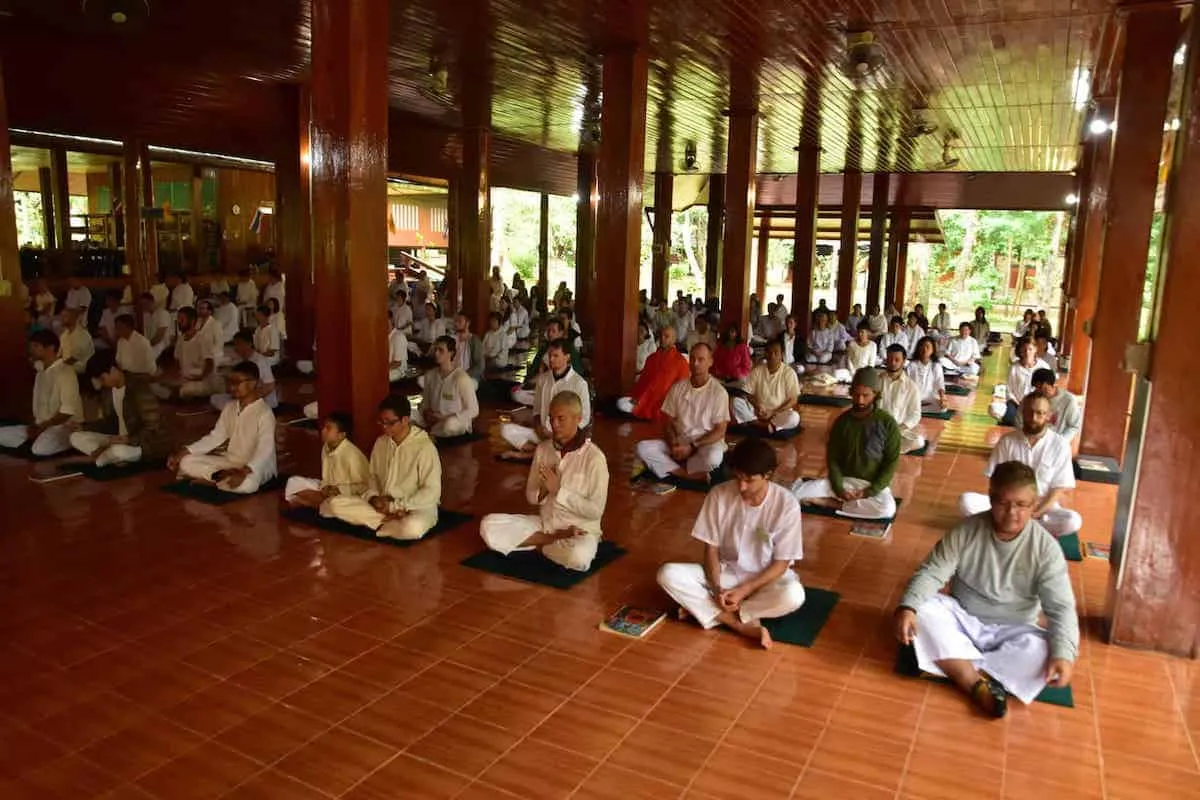
How to choose your first retreat
Verdict: if you have never done a retreat, pick a format you are sure you can finish. A flexible monastery stay is the gentlest start; a fixed 10-day silent course is a bigger commitment, but it is designed for beginners.
| Format | Example | Length | Silence | Good first choice if… |
|---|---|---|---|---|
| Open monastery stay | Wat Pa Tam Wua, northern Thailand | Usually 3–10 days, any arrival day | Optional outside class | you want structure but also flexibility and the chance to ask monks questions |
| Fixed silent course | Goenka Vipassana (dhamma.org); Suan Mokkh | 10 days; a Goenka course spans 12 days with arrival and departure | Noble Silence for almost the whole course | you can commit to every day and want a clear, single method |
| Long individual course | Wat Ram Poeng, Chiang Mai | 26-day basic course, at least 10 days to try it | No socializing, reading or writing | you have nearly a month and want daily contact with a teacher |
| Forest monastery as a guest | Wat Pah Nanachat | 3 days at first, normally up to 30 | Quiet routine, no courses | rarely a first choice: it expects previous retreat experience |
Before you commit, check five things on the retreat's own website:
- Length and dates. Can you stay for the whole period? Fixed courses expect you to.
- Language. Will you understand the teaching? My friend Mindaugas and I deliberately chose a monastery where the monks teach in English rather than a "wild" one, because for a first time we wanted to know exactly what to do and how to behave.
- Silence and phones. Is silence total or optional? Do you hand in your phone?
- Cost. Fee, donation only, or free? What does it include?
- Health conditions. Some retreats don't accept people with certain mental-health histories, and most expect you to cope with simple living.
For Thailand, I compare four options side by side, with costs and registration rules, in monastery meditation retreats in Thailand compared.
What a day on retreat looks like
Retreat days look alike almost everywhere: an early start, several blocks of meditation, simple meals and a talk in the evening. Here are two published timetables, one for a fixed course and one for an open monastery:
| Time | Goenka 10-day course (dhamma.org) | Wat Pa Tam Wua (official guest timetable) |
|---|---|---|
| 04:00–05:00 | 04:00 wake-up bell; 04:30–06:30 meditation | 05:00 meditation in your hut |
| Early morning | 06:30–08:00 breakfast and rest | 06:30 rice offering to the monks; 07:00 breakfast |
| Morning | 08:00–11:00 group and individual meditation | 08:00 Dhamma talk, walking, sitting and lying-down meditation |
| Midday | 11:00 lunch; 12:00–13:00 rest and teacher interviews | 10:30 food offering; 11:00 lunch, the last full meal |
| Afternoon | 13:00–17:00 meditation; 17:00 tea break | 12:50 afternoon class; 16:00 cleaning and helping |
| Evening | 18:00 group meditation; 19:00 discourse; 20:15 meditation; 21:00 questions | 18:00 chanting, meditation and a talk; 20:00 own practice or tea |
| Night | 21:30 lights out | 22:00 rest |
Sources: the dhamma.org code of discipline and the Wat Pa Tam Wua timetable, checked on 27 November 2026.
At Wat Pa Tam Wua, I promised myself before arriving that I would go to every activity, and I did. I got up before five and went to bed around ten. My alarm was set to 04:50 every day. What a monastery day looks like from the inside, from the alms round to the evening chanting, is described in a day in a Thai forest monastery.
The rules: silence and precepts
Silence
How strict the silence is depends on the place:
- Goenka courses: "Noble Silence" means silence of body, speech and mind, so no gestures or written notes either. It lasts from the start of the course until the morning of the last full day. You may still speak with the teacher and the course management.
- Suan Mokkh: a fully silent 10-day retreat. Phones, tablets and notebooks are deposited for the whole time.
- Wat Ram Poeng: no socializing or gossiping, no reading, writing or phone calls during the course, no talking at meals, and you don't discuss your practice with other meditators.
- Wat Pa Tam Wua: silence is optional. You can take a "Silent" badge at Information, and half the dining hall is for silent eating; classes are always silent.
Five and eight precepts
| Precept | Five precepts | Eight precepts |
|---|---|---|
| No killing | Yes | Yes |
| No stealing | Yes | Yes |
| No sexual activity on retreat | Yes | Yes |
| No lying | Yes | Yes |
| No intoxicants | Yes | Yes |
| No food after midday | – | Yes |
| No entertainment, jewelry or make-up | – | Yes |
| No high or luxurious beds | – | Yes |
Goenka courses ask new students to keep five precepts and returning students eight. Thai monasteries such as Wat Pa Tam Wua, Wat Ram Poeng and Wat Pah Nanachat ask all guests to keep eight. Some places soften the details: Wat Pa Tam Wua allows a little fruit or biscuits in the evening and small items of jewelry. Other common rules are separate quarters for men and women, no physical contact, and no mixing in other meditation techniques during the course.
One rule that surprised me at Wat Pa Tam Wua: no living being may be harmed, so you wave mosquitoes and flies away instead of swatting them. The monastery's view, as I summed it up in my diary, is "live and let live".
What's hard in the first days
Almost everyone struggles at first. These are the usual difficulties, with what the retreats themselves suggest and what we noticed at Wat Pa Tam Wua:
- Pain from sitting. Chairs are fine. At Wat Pa Tam Wua, Mindaugas chose a chair from the start because he is not very flexible. The monastery's advice is not to force yourself through sharp, worsening or persistent pain, but to adjust your posture and ask a teacher.
- Walking meditation feels strange. Mindaugas wrote in his diary that the slow walking felt odd at first: he didn't know what he was supposed to do or not do, or whether to look around. Bit by bit, he started concentrating on his body and on what was happening around him.
- Sleepiness. Lying-down meditation sent many people to sleep; you could hear the snoring. Buddhist teaching lists dullness and drowsiness as one of the five hindrances, alongside desire, ill will, restlessness and doubt. The Wat Pa Tam Wua guide to the five hindrances suggests opening your eyes, sitting up a little or switching to walking.
- Hunger. With no food after lunch, you go about 18 hours without eating. The monks recommended drinking more water, because people often confuse hunger with thirst. There was also an unwritten rule: if you really couldn't bear it, you could ask in the kitchen. You are there to train your will, not to suffer.
- Cold nights. In the mountains, nights can be colder than you expect. Mindaugas described his first night as windy and stormy, on a mattress that felt not much different from the floor.
- The pull of the phone. The monks recommended not wasting free time on social networks and phones, and reading, meditating more or simply sitting in nature instead.
- Impatience. I was told that you need at least three days to feel the real effect of being there. In my experience, the slow, quiet rhythm calmed my mind gradually, not all at once. Come without big expectations.
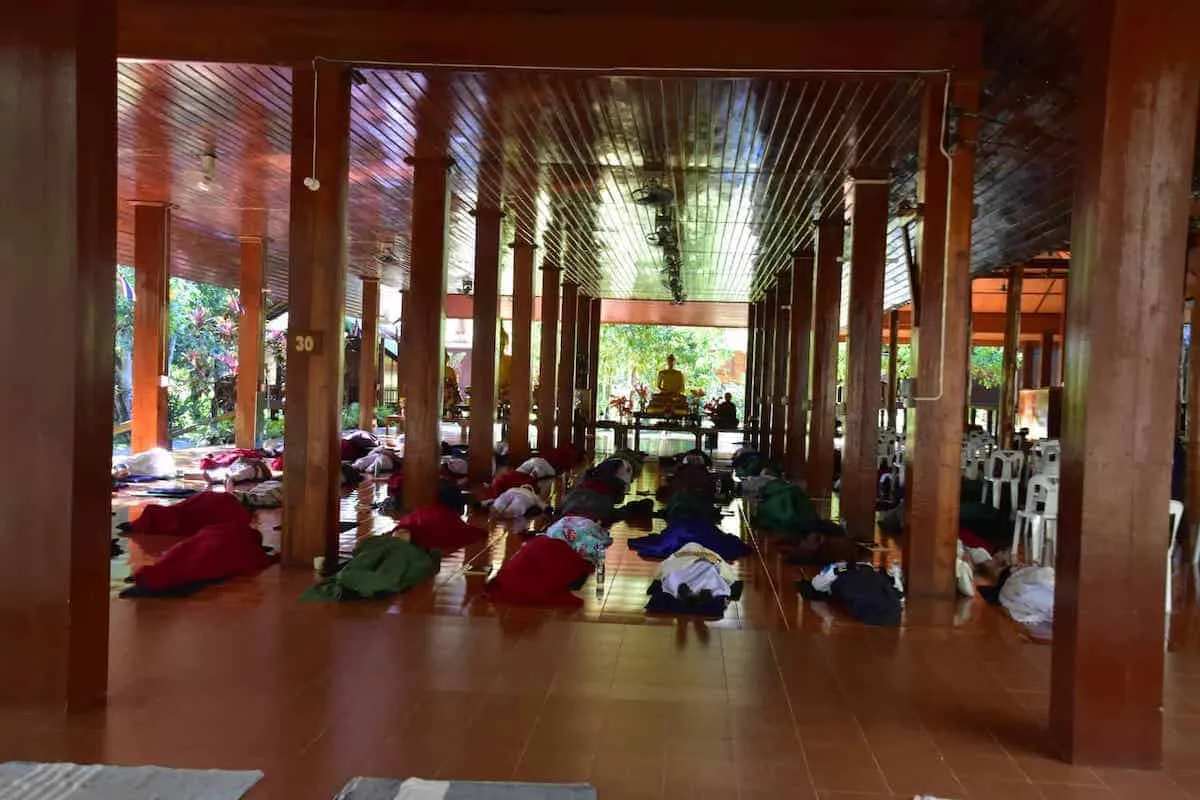
A retreat can also bring up strong emotions. Dhamma.org says that old symptoms may resurface during or after a course, and that meditation is no substitute for medical or psychiatric treatment. If you have a mental-health condition, talk to your doctor before you book and read the retreat's own policy.
What to pack
Retreats want you to travel simply. This list combines what the Thai retreats on this page ask for:
- Documents: your original passport with a valid visa or entry stamp, which the Thai monasteries check at registration.
- Modest clothes: loose and not see-through. Suan Mokkh asks for the body to be covered from the shoulders to below the knees, including the upper arms. Some places want white: Wat Pa Tam Wua lends white clothes, and Wat Ram Poeng asks for at least two white sets, white underwear included.
- An alarm clock that isn't your phone: Wat Ram Poeng asks for one that can be set in five-minute steps, and Wat Pah Nanachat for a classic alarm clock.
- A torch, mosquito repellent and toiletries, plus a towel and any medication.
- Sandals or flip-flops that slip off easily, because shoes come off before you enter halls and buildings.
- A warm layer and rain gear, especially in the mountains and in the rainy season.
- A padlock for valuables (Wat Pah Nanachat suggests one) and a little cash for the shop and transport.
Leave at home: jewelry and make-up if you will keep eight precepts, and anything you would hate to lose. Where reading is allowed, as at Wat Pa Tam Wua, one book is enough; the evenings there were my favorite time for reading.
Before you go
- Settle your affairs. Suan Mokkh asks you to arrange all phone calls, tickets, money changing and visa extensions before the retreat, because there is no way to do them during it.
- Talk to work and family. If you are a freelancer and can't disconnect completely, agree on it with your clients beforehand. I kept doing a little work in the monastery for my regular clients, because it wouldn't have been fair to disappear on them for weeks.
- Leave your dates with someone and save the address and your onward travel details offline.
- Practise a little at home. Sit still for 20–30 minutes, get up early and try skipping the evening meal for a few days.
After the retreat
The usual advice is not to try to copy the retreat timetable at home. Wat Pa Tam Wua's guide to meditation after a retreat suggests:
- Start small. Five or fifteen minutes at a time you can actually keep, using one instruction you understand.
- Don't measure yourself against retreat calm. Home has messages, work and other people. Noticing that the mind wandered and coming back is the practice.
- Restart after a missed day without "making up" the minutes.
- Review once a week what worked and change one detail.
- Find a teacher or a sitting group you can ask about your own practice.
Some things stay with you. About a week into my stay, I walked to the small shop next to the monastery for an ice cream, and holding my wallet felt strange. In that moment I saw clearly how much mental energy money and work take, even for a relaxed freelancer travelling the world. Would I go back? One hundred percent, and I recommend everyone try it at least once.
Frequently asked questions
Is a 10-day silent retreat too much for a beginner?
Not necessarily. Wat Pah Nanachat describes about 10 days as a typical retreat for beginners, and Goenka Vipassana courses and Suan Mokkh accept first-timers. But you commit to all 10 days, in silence, with a full timetable. If you are unsure, start with something shorter and more flexible, such as a 3–10-day stay at an open monastery like Wat Pa Tam Wua.
Do I need meditation experience for my first retreat?
Usually not. Wat Pa Tam Wua, Suan Mokkh and the Goenka 10-day courses all accept complete beginners. Some places do ask for experience: Wat Pah Nanachat offers no courses and wants guests to have done a retreat first.
Can I keep my phone on a meditation retreat?
It depends on the place. Suan Mokkh and Wat Ram Poeng keep phones in safe-keeping for the whole course, and Wat Pah Nanachat asks guests not to bring them. Wat Pa Tam Wua lets you keep yours if it stays silent during classes and chanting. Check the rules before you go and tell your family how to reach you in an emergency.
What if I can't sit cross-legged?
Use a chair. Wat Pa Tam Wua provides chairs as well as floor cushions, and no leg position is a test of how serious you are. Change position when you need to, and don't force yourself through sharp or worsening pain; tell a teacher instead.
Are meditation retreats free?
Many are. Goenka Vipassana courses run only on donations, and Wat Pa Tam Wua and Wat Pah Nanachat give food and lodging free. In Thailand, Wat Ram Poeng asks a one-time 500 THB fee and Suan Mokkh 2,000 THB for 10 days (checked on 27 November 2026). Travel and visas are always your own cost.
Can I leave a retreat early?
Nobody can hold you, but fixed courses ask you to commit to the whole period: dhamma.org says students commit to staying for the entire 10-day course. Suan Mokkh asks you to leave after the pre-registration interview if you are not sure you can take part fully. Open monasteries are more flexible about your departure date.
Is a meditation retreat safe if I have anxiety or depression?
Talk to your doctor first and read the retreat's health policy. Dhamma.org says Vipassana is not a substitute for medical or psychiatric treatment and does not recommend its courses for people with significant mental health issues. Suan Mokkh and Wat Pah Nanachat also set mental-health conditions for guests.
Ready to choose? Compare monastery meditation retreats in Thailand, or read my complete Wat Pa Tam Wua guide. More English pages are on Gyvenimo Laisvė in English.