A day in a Thai forest monastery: what monks actually do
In a Thai forest monastery, monks wake before dawn to chant and meditate, receive food that lay people offer, eat before noon and spend the rest of the day on meditation, study, teaching and shared work. The day ends with evening chanting. I watched this rhythm from the guest side for 20 days at Wat Pa Tam Wua.
This page keeps two kinds of information apart. What I saw myself comes from the second part of my Lithuanian diary about daily life in the monastery, published in 2020. What I didn't see, such as the monks' private routine and how ordination works, comes from the monasteries' own websites, checked on 27 November 2026, and is marked as second-hand. Disclosure: I built the Wat Pa Tam Wua website as a volunteer and still maintain it.
A forest monastery day at a glance
No single timetable applies to every Thai monk. The middle column shows the general shape of a forest-monastery day, using the routine Wat Pah Nanachat publishes. The right column is the guest day I lived at Wat Pa Tam Wua, which matches the monastery's current official timetable almost exactly.
| Part of the day | Typical forest-monastery routine (second-hand) | Guests at Wat Pa Tam Wua (my diary and the official timetable) |
|---|---|---|
| Before dawn | Wake, chant and meditate; Wat Pah Nanachat's morning meeting is at 03:30 | 05:00 meditation in your own hut |
| Dawn | Alms round in nearby villages; at Wat Pah Nanachat, lay guests sweep or help in the kitchen meanwhile | 06:30 rice offering to the monks in the hall, then breakfast at 07:00 |
| Morning | The meal (one a day at Wat Pah Nanachat) and a short Dhamma teaching (09:30 at Wat Pah Nanachat) | 08:00 talk by a monk, walking, sitting and lying-down meditation, then questions |
| Before noon | All ordinary food finished before noon | 10:30 food offering to the monks, 11:00 lunch, the last full meal |
| Afternoon | Meditation alone, study, receiving visitors; sweeping, repairs and robe care | Second lesson with a different monk (13:00 in my diary, 12:50 today), then cleaning and small jobs from 16:00 |
| Evening | Chanting and meditation (18:15 at Wat Pah Nanachat) | 18:00 chanting in Pali, meditation in the dark and a short talk; 20:00 own practice or tea; 22:00 quiet |
Sources: Wat Pah Nanachat's visitor page, the Wat Pa Tam Wua timetable and its guide to the Theravada monastic daily routine, checked on 27 November 2026.
Before dawn: morning meditation
My alarm rang at 04:50 every day. By about five I had washed, dressed and sat down to meditate. The monastery encourages guests to get up before five, and the monks liked the saying "win the first hour of the day and you win the day". In my diary I explained it the way Eastern traditions do: early in the morning there is little noise, bustle or engine fumes yet, so it is the calmest time for spiritual practice.
One of my favorite things was to walk out after the morning sit and watch the sun come up. In the official timetable this hour is still personal practice in your hut or room; it is not a group session.
Second-hand: the monks themselves often start earlier. Forest monasteries commonly rise between about 03:00 and 05:00, and at Wat Pah Nanachat the morning meeting for chanting and meditation is at 03:30.
The alms round and the food offering
In the classic alms round, called piṇḍapāta in Pali, monks walk with their bowls through the nearby villages and receive food that people freely choose to give. They don't ask for anything or pay for it. At Wat Pah Nanachat, the monks go out at dawn. This street version is the one I did not see myself.
What I took part in at Wat Pa Tam Wua was the version inside the monastery. Before breakfast, everyone took a plate of rice and sat on the floor, with the women sitting separately. Gongs announced that the monks were coming. Each monk carried his own bowl and walked past every person in the hall, and we each put a spoonful of rice into every monk's bowl.
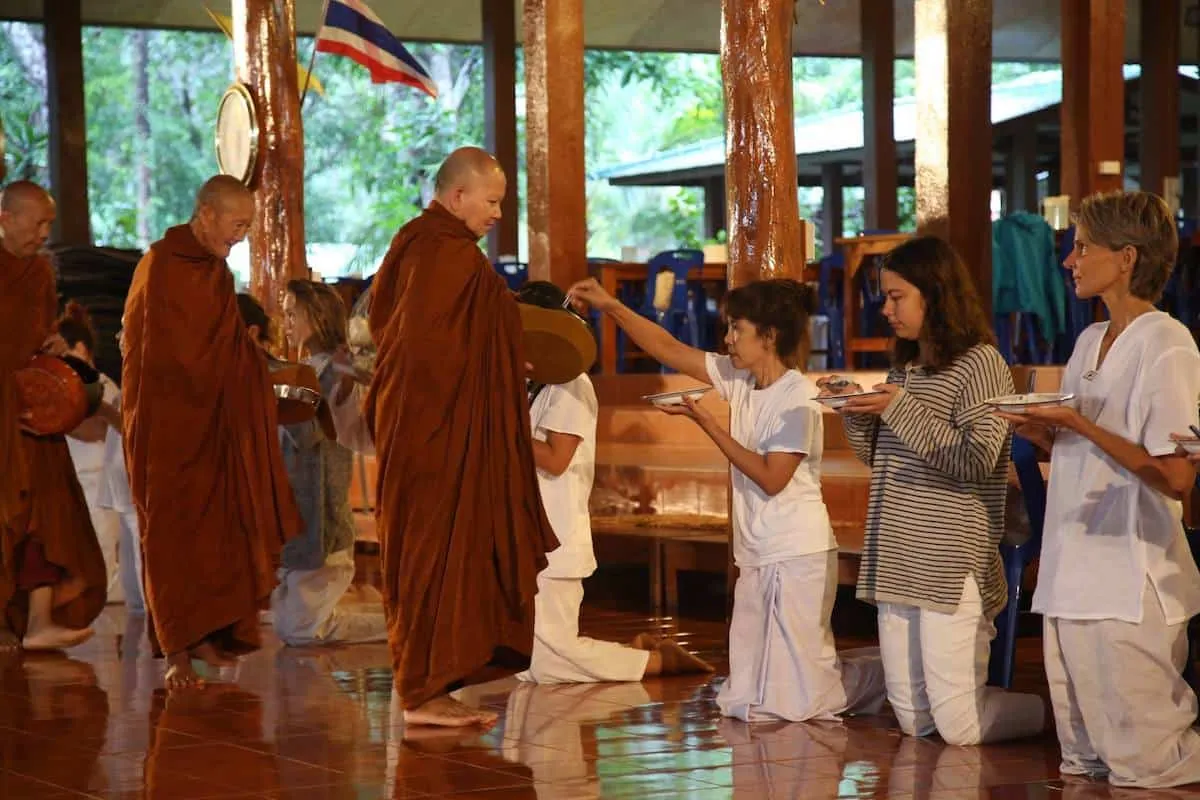
Then the monks sat on chairs at the end of the hall, and the most senior of them gave the morning talk. He greeted everyone, thanked people for preparing and offering the food and explained the plans for the day. Usually this was the abbot, Sajut, who founded the monastery. As I learned there, he once lived alone in the jungle for 7 years, 7 months and 7 days under a vow of silence. Afterwards all the monks chanted a short blessing of thanks, and then they left for their own area, where they spend most of their time meditating and putting up new buildings.
Lunch had a similar ritual. This time people handed the monks trays of food, and each monk took what he needed into his bowl. After the blessing chant, everyone else ate.
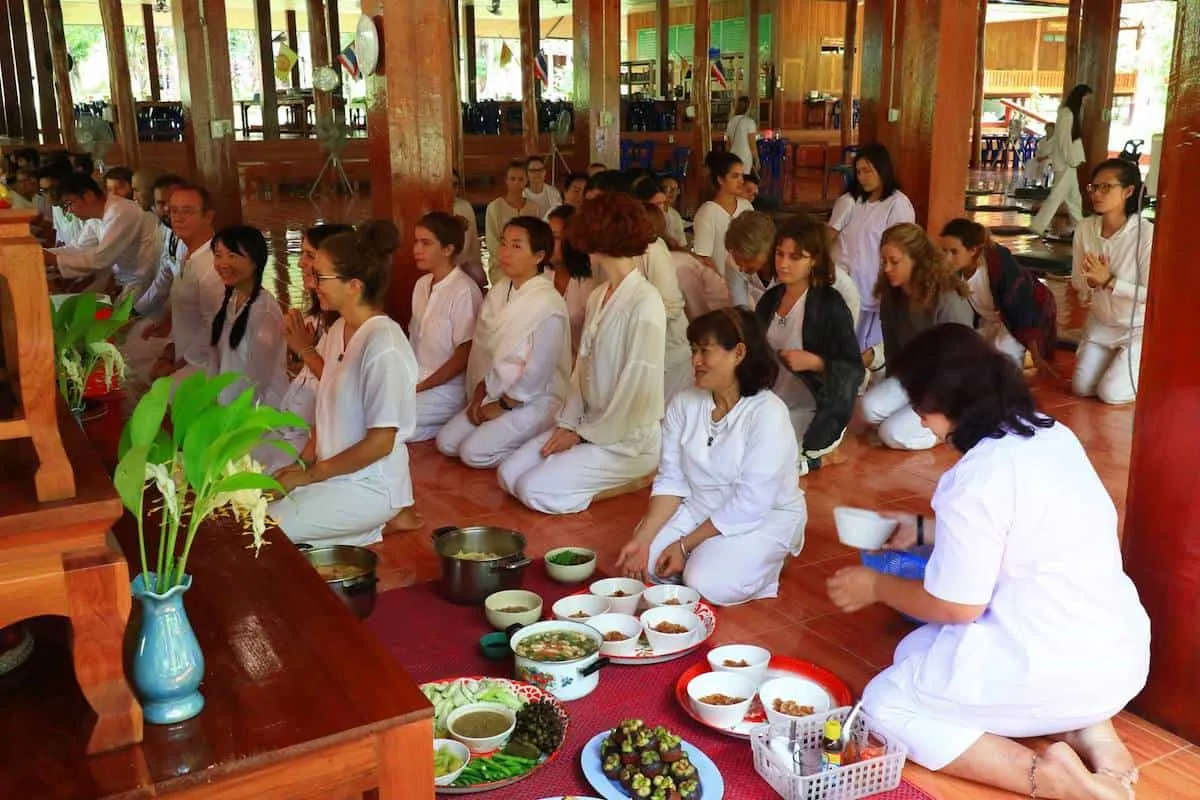
What we were told: Buddhist monks can't cook for themselves and eat only what people offer them. If nobody offers anything, the monk doesn't eat. For Thais, giving food to monks is one of the best ways to make good karma, and the blessing chant they receive in return is one of the most respected chants in Buddhism.
Today's guest rules (official): the rice offering is at 06:30 and the formal food offering at 10:30, and both are mandatory for overnight guests. At the formal offering, women place the food in front of the abbot, because he cannot take it directly from a woman; men hand it to the monks. According to the Forest Sangha, forest monks eat only between dawn and noon.
Lessons: Dhamma talks and meditation
After breakfast and some free time, the monks sat down in the big hall and we sat facing them. Men sat at the front, nearer the monks, and women at the back. It sounds a little sexist, I know, but that is the tradition, and contact between women and monks is kept as discreet as possible.
One of the monks then spoke on a topic of his own choosing, from a Buddhist point of view: how to use meditation in daily life, how karma works, how to forgive yourself for past mistakes, what Buddhists see as the meaning of life. Sometimes one topic ran over several days.
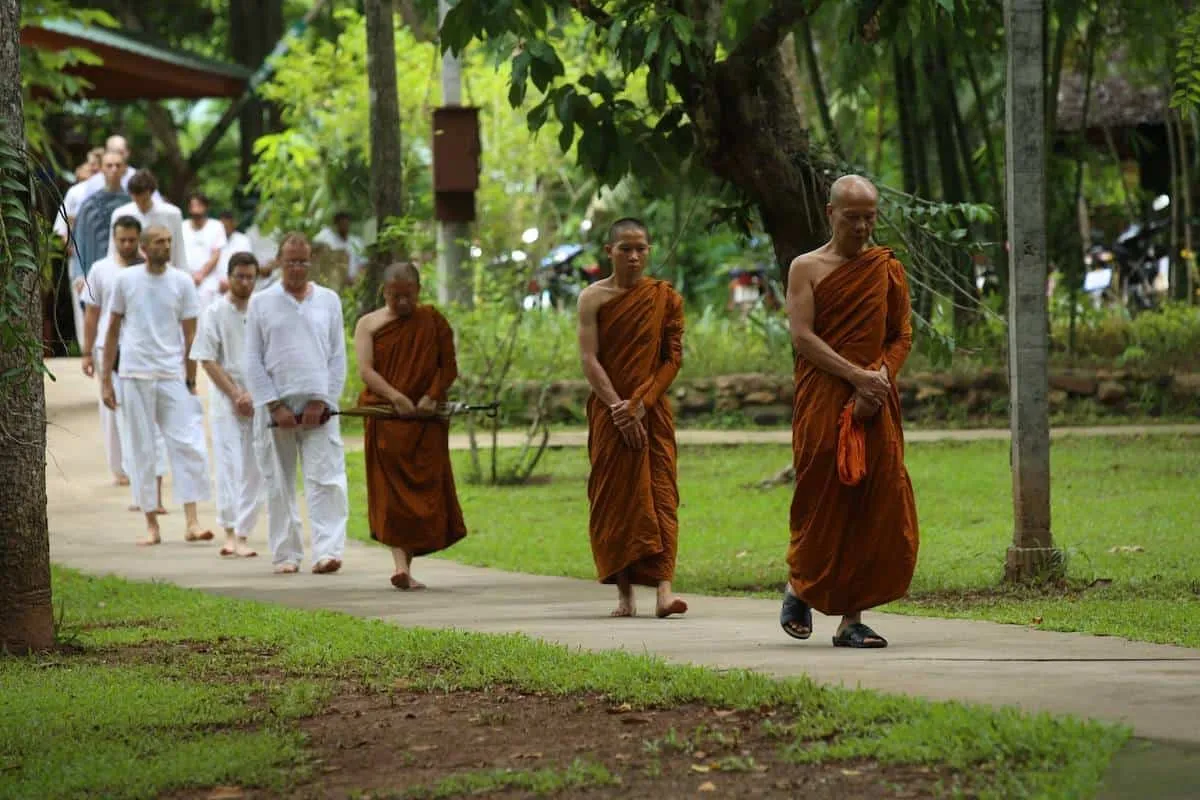
After the talk came walking meditation, usually 30–40 minutes around the grounds: the paths, the garden, the forest, around the lake. The monks walked first and everyone followed in a slow line, watching their own thoughts, feelings and emotions as they walked.
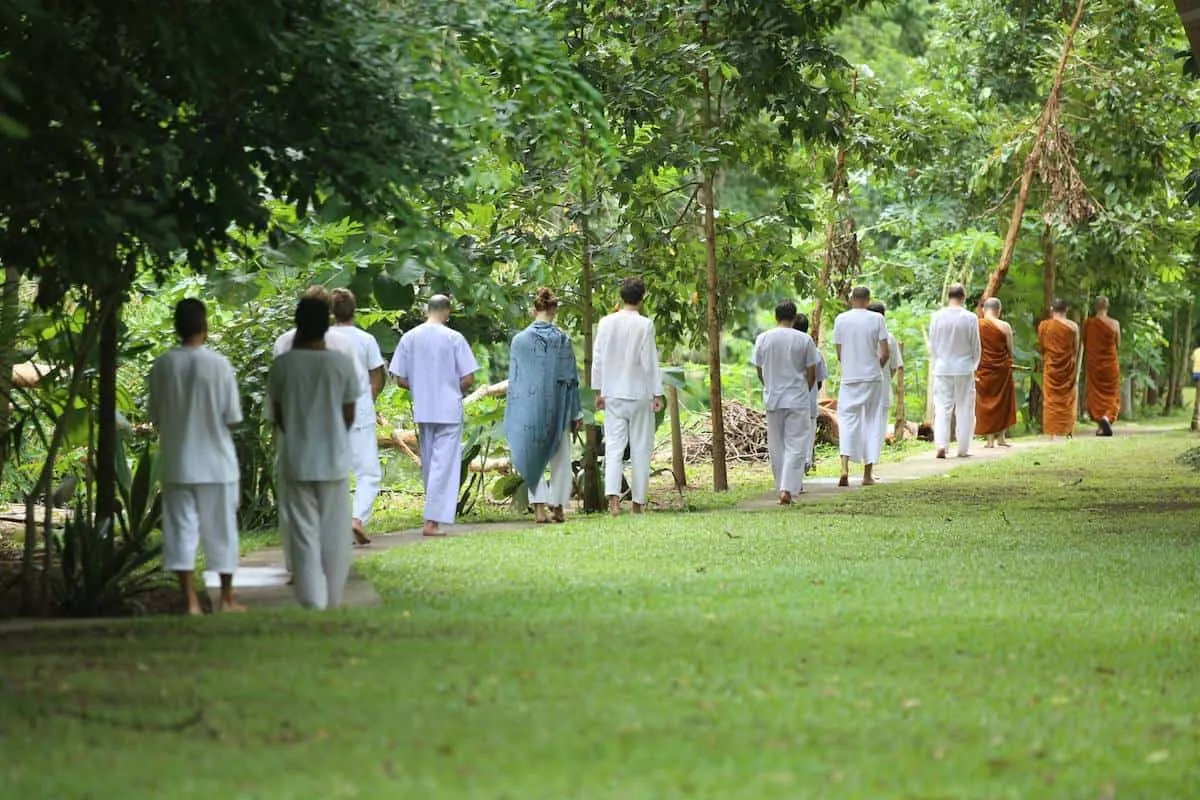
Back in the hall, we sat. You could choose Samatha, keeping your attention on one object such as the breath, or Vipassana, watching your sensations, emotions and mind from moment to moment. Last came lying-down meditation. For many people it was the favorite, judging by the snoring, and the monks liked to joke that the sounds showed how deeply people had meditated that day.
Then came free time, and some of us sat down next to a monk to ask questions. For me this was the most interesting part of the day, and I always looked forward to it. The afternoon lesson worked the same way, with a different monk choosing the topic. It was usually led by Pradžan Anik, the monastery's main teacher and the author of a book on Buddhism and meditation, and it became my favorite.
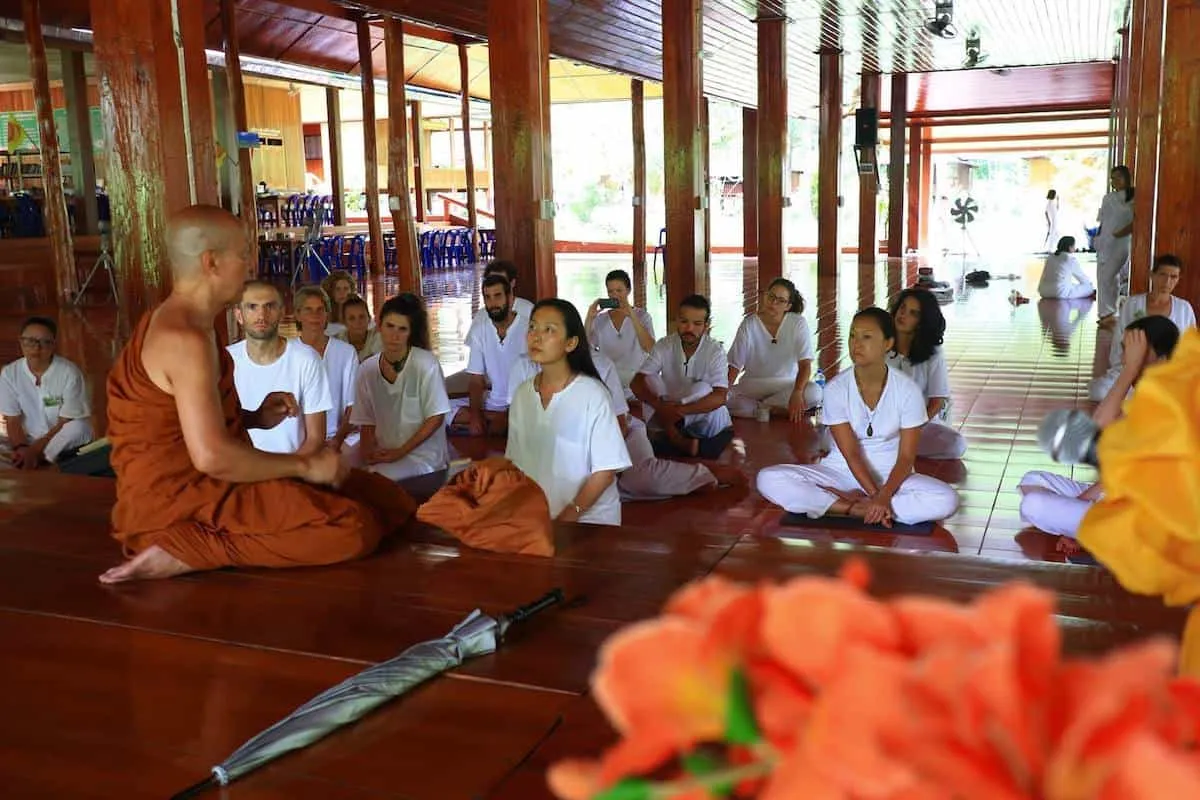
Today (official): the classes are at 08:00 and 12:50. Each one opens with a Dhamma talk in Thai and English, followed by about 40 minutes of walking, 40 of sitting and 15 of lying-down meditation. For the monks, teaching guests is only one part of the day. Study, their own meditation and community business take up the rest.
Chores, work and building
After the second meditation there were about two hours of free time. The monastery asked everyone to give at least an hour of it to helping: wiping tables, sweeping leaves on the grounds, tidying your own house. Sometimes there were other jobs, such as carrying tables and chairs for an upcoming festival, because the monastery celebrates traditional Thai and Buddhist festivals.
All the food was cooked by volunteers, who started in the kitchen at 5 am. My friend Mindaugas, who used to work as a cook, asked to help there and often did. I volunteered in a different way: I built the monastery a new website.
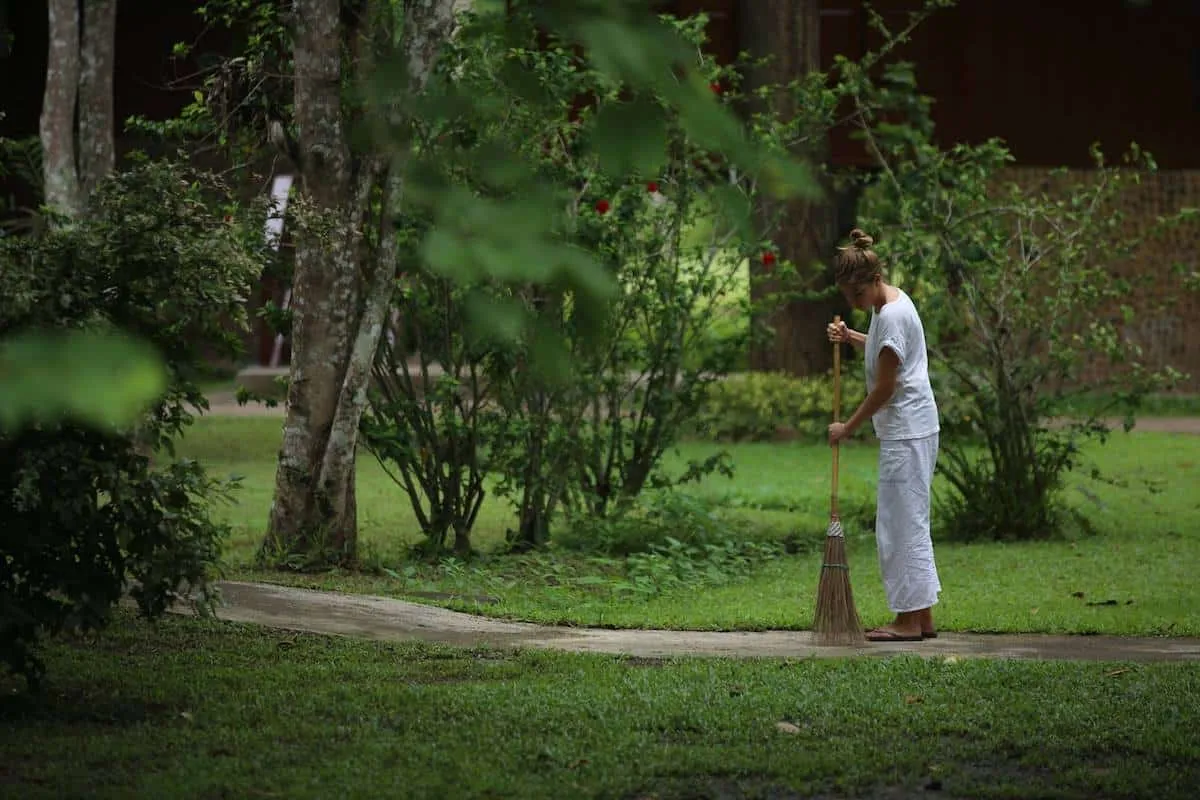
The monks work too. They often help build new houses or paint statues, and the monastery was constantly putting up new buildings and guest huts. Anyone with experience in building, gardening or cooking was a useful pair of hands.
Second-hand: in the forest tradition, ordinary work such as sweeping, washing bowls, repairing huts and sewing robes is treated as part of the training, a chance to stay mindful while the body is busy. The current Wat Pa Tam Wua rules ask for help in the kitchen at 05:00, with the meditation cushions at 07:30 and 17:30, and with leaf raking at 16:00.
Evenings: chanting in Pali and meditation in the dark
After two more hours of free time, everyone gathered in the hall again for chanting and the third group meditation. Almost all the monks came to this one. Each of us took a book of chants. A monk read aloud and everyone read along with him. The chants are about everything in life having a beginning and an end, about people not being eternal, about thanking the Buddha and one's teachers and about wishing happiness to all living beings. They are all in Pali.
Then the monk announced that the next meditation would be Samatha, watching the breath, and the lights went out. That was around 7 pm, and in the tropics the sun sets at about six, so it was already completely dark. We sat in total darkness, hearing only the crickets and now and then a lizard or a bird. Meditating in the dark with a whole group of people was a strange and very special experience.
Afterwards the monks thanked everyone for the day, wished us a good night and told us the plans for tomorrow. Some people went to their huts; others sat at the table with tea or a book. The monks recommended a calm meditation before sleep. For me, it was the best time to read, but I never stayed up long, because I wanted to get up early again.
Today (official): evening chanting starts at 18:00 and lasts around 45 minutes, followed by about 40 minutes of meditation and a short Dhamma talk.
The rules monks live by
The monks wear brown-orange robes. I was told that in Buddhism these robes have been considered sacred for thousands of years, and that a person who puts them on takes on a set of rules and restrictions at the same moment. Fully ordained monks keep 227 rules, including total celibacy, eating only between dawn and noon and not handling money, according to the Forest Sangha.
| Lay guest | Novice (samanera) | Monk (bhikkhu) | |
|---|---|---|---|
| Precepts | 8 during a monastery stay | 10 | 227 training rules |
| Clothes | White | Robes, the same color as a monk's | Robes |
| Money | Can use it | Gives up using money | Doesn't accept or use money |
| Food | No food after midday under the Eight Precepts (Wat Pa Tam Wua allows a little fruit or biscuits) | Before noon | Before noon |
Sources: Wat Pa Tam Wua's guide to monks, novices and lay guests, its rules and Wat Pah Nanachat's training page, checked on 27 November 2026.
How to become a Buddhist monk in Thailand as a foreigner (second-hand)
Second-hand: I have never ordained, and nothing in this section comes from my diary. It summarizes what Wat Pah Nanachat and the Wat Pa Tam Wua website publish, checked on 27 November 2026.
Foreign men can become Buddhist monks in Thailand, but you can't just sign up for it like a retreat. You join a monastery that trains foreigners, live there as a guest, and then move through stages that the community agrees to one at a time. At Wat Pah Nanachat, the English-speaking forest monastery founded by Ajahn Chah, this takes about a year and a half or more before full ordination.
| Stage | What it means | At Wat Pah Nanachat |
|---|---|---|
| Eight-precept guest | A lay guest in white, following the monastery routine | More than a month |
| Anagarika (Thai: pah-kow) | A white-robed postulant who keeps eight precepts and still manages his own money | About six months |
| Samanera (novice) | "Going forth" (pabbajja): brown robes, ten precepts, no more handling of money | At least a year |
| Bhikkhu (monk) | Full ordination (upasampada) and the full monastic code | At least five years in dependence on a teacher |
What Wat Pah Nanachat asks on its training page:
- a genuine interest in long-term training in the communities of Ajahn Chah, not a short trial;
- your parents' permission for novice and monk ordination;
- an age limit of about fifty;
- no debts, no government service obligations and no major diseases such as epilepsy, HIV or cancer;
- no history of mental illness, including depressive phases, because professional help for foreigners in Ubon is very limited;
- health or travel insurance and enough money for emergencies, possible visa extensions and onward travel. Until you become a novice, visas are your own responsibility; after that, the monastery handles your visa applications.
Separately, the monastic code sets a minimum age of 20 for full ordination, counted from conception, according to The Buddhist Monastic Code. To ask about a first visit, Wat Pah Nanachat wants an email to its guest monk at least two weeks ahead.
Temporary ordination
Temporary ordination is part of Thai Buddhist life: a man may spend a limited time in robes and then return to his family or work. According to the Wat Pa Tam Wua guide to becoming a monk in Thailand, not every monastery offers it or accepts foreigners for it. A short ordination has to be arranged as such with a host. A long-term path like Wat Pah Nanachat's cannot simply be shortened to fit a holiday.
Can you start at Wat Pa Tam Wua?
Only as a lay guest. Wat Pa Tam Wua's program has no ordination pathway, but it is an easy place to find out whether you like early mornings, two meals a day and communal life. See my Wat Pa Tam Wua guide and the comparison of Thai monastery retreats, which includes Wat Pah Nanachat.
Can women become nuns in Thailand? (second-hand)
Yes, but the paths are different from the men's, and the English word "nun" covers several of them. According to the Wat Pa Tam Wua guide to monks, novices and lay guests:
- Mae chi: women renunciants in Thailand who usually wear white and keep eight precepts.
- Samaneri: women who have taken novice ordination and ten precepts.
- Bhikkhuni: fully ordained women with their own monastic discipline.
- Siladhara: a separate women's training form developed in Ajahn Chah's communities in Britain.
A woman who wants to ordain needs a community that trains women and has women teachers. Wat Pah Nanachat has no resident nuns and refers women to the nuns' community at Amaravati Buddhist Monastery in England. The bhikkhuni community Dhammadharini describes stages much like the men's: usually two or three months as an eight-precept pre-postulant, then around a year as an anagarika, then novice ordination. It adds that a woman with a dependent child must arrange other care, and that a married woman needs her husband's blessing.
As lay guests, women are welcome at both monasteries on this page. Wat Pa Tam Wua has huts and three dormitory buildings for women. Wat Pah Nanachat accepts female guests, but because there is no resident woman teacher, it advises having enough meditation experience to practise on your own.
Frequently asked questions
What does a Buddhist monk do all day in a Thai forest monastery?
He meditates before dawn, receives food offered by lay people, eats before noon, then spends the day on sitting and walking meditation, study, teaching visitors and shared work such as sweeping and building. The day ends with chanting and meditation. Each monastery sets its own clock times.
What time do monks wake up in Thailand?
There is no single time. Forest monasteries often start between about 03:00 and 05:00. Wat Pah Nanachat holds its morning chanting and meditation at 03:30. At Wat Pa Tam Wua, the guest timetable starts with meditation in your hut at 05:00.
Do Thai monks eat only once a day?
Not all of them. The monastic rule is about time: ordinary food is eaten between dawn and noon. Stricter forest monasteries such as Wat Pah Nanachat eat one meal a day. Many other monasteries have two meals before noon, and lay guests at Wat Pa Tam Wua get breakfast and lunch.
Can a foreigner become a Buddhist monk in Thailand?
Yes, if a monastery accepts you for training. Wat Pah Nanachat trains foreign men in English. You stay more than a month as a guest, about six months as a white-robed postulant and at least a year as a novice before full ordination. You need your parents' permission and no debts, and that monastery's age limit is about 50.
Can I become a monk in Thailand for a few weeks?
Temporary ordination is part of Thai Buddhist life, but not every monastery offers it or accepts foreigners for it. It has to be arranged as a short ordination with a host. A long-term training path like Wat Pah Nanachat's cannot simply be shortened to fit a holiday.
How can a woman become a Buddhist nun in Thailand?
The paths differ from the men's. Mae chi are women renunciants in Thailand who usually wear white and keep eight precepts. Samaneri are female novices with ten precepts, and bhikkhuni are fully ordained nuns. You need a community that trains women; Wat Pah Nanachat, for example, refers women to the nuns at Amaravati in England.
Can I become a monk at Wat Pa Tam Wua?
No. Wat Pa Tam Wua's program is for lay meditation guests and has no ordination pathway. Guests wear white and follow the guest timetable; finishing a stay does not make you a novice or a monk.
Want to try this life for a few days? Start with your first meditation retreat: what to expect, or read my complete Wat Pa Tam Wua guide. More English pages are on Gyvenimo Laisvė in English.